
⇐ Hitchhiker's thumb |
PTC tasting ⇒
Table of Contents
Genetics of finger hair
Summary
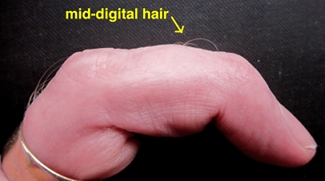
You might have heard that there are two kinds of people, those with hairs on the middle segments of their fingers and those without hairs, and you might have heard that the presence of hairs is a dominant genetic trait. This is not true! Scientists have found that the presence of these hairs varies with age and can differs from one hand to the other, and studies of families have shown that hairs are not inherited as a dominant genetic trait. Don't worry if your family includes two parents without mid-digital hair and a child with the hairs, and if you're a teacher, don't use mid-digital hair as an example of a simple genetic trait.
Is mid-digital hair a yes-or-no trait?
Look at the middle segment of each of your fingers, and see whether any of them have hairs. Some people have a lot of hair on the middle segments of all of their fingers, while others have just a few hairs on one finger. It would be possible to count the hairs and treat mid-digital hair as a measurement (like height or weight), but biologists generally divide people into two categories, mid-digital hair present (H) or absent (N).
(Garn [1951] said "middle phalangeal hair" would be a more accurate name for hair on the middle segments [phalanges], as "mid-digital hair" implies hair on the middle finger; the scientific literature mostly uses his term, while genetics textbooks and web pages tend to use "mid-digital hair.")
Danforth (1921) was the first to consider mid-digital hair as a possible genetic trait. He pointed out how hard it could be to divide people into two categories, "present" or "absent": the hairs can be on all four fingers, or just one, and can range from numerous and thick to scarce and very fine. In some cases, he could see hair follicles but no hairs, which Danforth and most subsequent researchers counted as having hair present.
Bernstein and Burke (1942) reported that mid-digital hair was present in about half of females under 21, with a slightly higher percentage in males, but less than 20 percent of women over 21 had mid-digital hair. They suggested that housework wore away the mid-digital hair and hair follicles. If people change from H to N during their lifetime, then mid-digital hair isn't a completely genetic trait, it's at least partly determined by the environment.
Ikoma (1973) surveyed the left hands of over 7,500 people in Japan. About 24 percent had at least one finger with mid-digital hair. The most common patterns were hair on just the ring finger or the ring finger and middle fingers, with middle, ring, and pinkie fingers being somewhat less common. Less than one percent of people had mid-digital hair on their index finger.
Saldanha and Guinsburg (1961) reported that over 10 percent of a sample of Brazilians had mid-digital hair on one hand but not the other. Other studies (Danforth 1921, Bernstein and Burks 1942, Ikoma 1973) only looked at the left hand, so they would have classified some people as N who actually had mid-digital hair on their right hand.
Family studies
Danforth (1921) was the first to examine the genetic basis of mid-digital hair by comparing parents and offspring. Unfortunately, his sample of 80 families did not include any N×N matings. He concluded that his data were fairly consistent with H being dominant, but with some evidence that multiple genes or environmental factors influenced the trait.
Bernstein and Burks (1942) collected family data, with the following results:
| Parents | H offspring | N offspring | percent H |
|---|---|---|---|
| H×H | 60 | 12 | 83% |
| H×N | 54 | 55 | 50% |
| N×N | 20 | 214 | 9% |
They suggested that H was dominant over N. If this were true, two N parents could not have an H child. Bernstein and Burks (1942) say the 20 H offspring of N×N matings could be explained if some of the "N" mothers were really H women whose mid-digital hair follicles had been worn away by housework.
Kloepfer (1946), Bernstein (1949), and Beckman and Böök (1959) collected family data, with similar results:
| Parents | H offspring | N offspring | % H |
|---|---|---|---|
| H×H | 38 | 12 | 76% |
| H×N | 26 | 16 | 62% |
| N×N | 1 | 7 | 13% |
| Parents | H offspring | N offspring | % H |
|---|---|---|---|
| H×H | 114 | 14 | 89% |
| H×N | 46 | 33 | 58% |
| N×N | 9 | 51 | 15% |
| Parents | H offspring | N offspring | % H |
|---|---|---|---|
| H×H | 42 | 13 | 76% |
| H×N | 31 | 26 | 54% |
| N×N | 9 | 21 | 30% |
All of these results show that their is a genetic influence on mid-digital hair (because H×H matings have more H offspring than do N×N matings), but none of them fit the textbook story that H is dominant (because N×N matings produce H offspring).
Hindley and Damon (1973) collected family data in the Solomon Islands. They note that they did not use a magnifying glass, so they may have missed small, fine hairs and follicles without hair. They also had blood group data, so they were confident that all the parents were correctly identified (no hidden adoptions or false paternity). They obtained the following results:
| Parents | H offspring | N offspring | Percent H |
|---|---|---|---|
| H×H | 6 | 10 | 38% |
| H×N | 17 | 21 | 45% |
| N×N | 11 | 13 | 46% |
Unlike previous studies, these data show no genetic influence on mid-digital hair; about the same proportion of children have mid-digital hair for all three mating types.
Twin studies
Sommer (1971) looked at the fingers of 28 pairs of identical twins, and found one pair in which one twin had mid-digital hair while the other twin did not. This is more evidence that the trait is affected by the environment as well as genetics.
Further research
Multiple family studies have shown that mid-digital hair is not the single-gene, two-allele trait that some textbooks say, so there doesn't seem to be any reason to do more research on the genetics of this trait.
Oinonen (2009) counted the mid-digital hairs on the ring and pointer fingers of 88 Canadian undergraduates, and found that women with negative side effects of oral contraceptives had fewer mid-digital hairs. It has been speculated that hormone levels are related to the presence/absence and number of mid-digital hairs (Garn 1951), and there is some evidence for a relationship in men (Knussman et al. 1992), so the intriguing relationship between the side effects of synthetic hormone use by women and mid-digital hairs is not completely bizarre. One complication is that the presence/absence of mid-digital hairs (and presumably the number of hairs) varies widely among ethnic groups (Westlund et al. 2015). I don't know if the the side effects of oral contraceptives differ among ethnic groups (for genetic or socio-economic reasons), but if they do, that could explain the results in Oinonen (2009). Further research that controlled for ethnicity would be fairly easy, requiring only a magnifiying glass, a questionnaire, and an informed consent form, and it might confirm an interesting result.
References
Beckman, L., and J.A. Böök. 1959. Distribution and inheritance of mid-digital hair in Sweden. Hereditas 45: 215-220.
Bernstein, M.M. 1949. The middigital hair genes. Their inheritance and distribution among the white race. Journal of Heredity 40: 127-131.
Bernstein, M.M., and B.S. Burke. 1942. The incidence and mendelian transmission of mid-digital hair in man. Journal of Heredity 33: 45-53.
Danforth, C.H. 1921. Distribution of hair on the digits in man. American Journal of Physical Anthropology 4: 189-204.
Garn, S.M. 1951. The use of middle-phalangeal hair in population studies. American Journal of Physical Anthropology 9: 325-334.
Hindley, S.W., and A. Damon. 1973. Some genetic traits in Solomon Island populations. IV. Mid-phalangeal hair. American Journal of Physical Anthropology 39: 191-194.
Ikoma, E. 1973. A genetic study on digital hair. Japanese Journal of Human Genetics 18: 259-273. [in Japanese]
Kloepfer, H.W. 1946. An investigation of 171 possible relationships in man. Annals of Eugenics. 13: 35-71.
Knussmann, R., K. Christiansen, and J. Kannmacher 1992. Relations between sex hormone level and characters of hair and skin in healthy young men. American Journal of Physical Anthropology 88: 59—67.
Oinonen, K.A. 2009. Putting a finger on potential predictors of oral contraceptive side effects: 2D:4D and middle-phalangeal hair. Psychoneuroendocrinology 34: 713–726.
Saldanha, P.H., and S. Guinsburg. 1961. Distribution and inheritance of middle phalangeal hair in a white population of Sao Paulo, Brazil. Human Biology 33: 237-249.
Sommer, K. 1971. Untersuchungen zur Genetik des Merkmals "Fingerbehaarung." Humangenetik 11: 155-168.
Westlund, N., K.A. Oinonen, D. Mazmanian, and J.L. Bird. 2015. The value of middle phalangeal hair as an anthropometric marker: A review of the literature. Homo 66: 316-331.
Go to John McDonald's home page
This page was last revised October 26, 2026. ©2026 by John H. McDonald. Content is available under the Creative Commons Attribution-Noncommercial license.