
⇐ Hair whorl |
Hitchhiker's thumb ⇒
Table of Contents
Genetics of hand-clasping
Summary
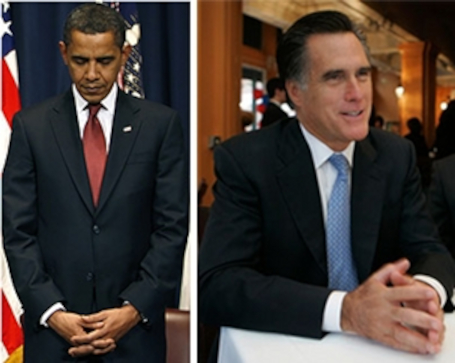
When you clasp your hands, you either have your right thumb on top, or your left. You may have heard that left thumb on top is a dominant genetic trait, but that's not true! Studies of families and twins have made it clear that genetics doesn't have a major influence on how you clasp your hands. Don't worry if your family includes two right-on-top parents and a left-on-top child, and if you're a teacher, don't use hand clasping as an example of a genetic trait.
Are there just two kinds of hand claspers?
Clasp your hands, with the fingers interdigitated (what a delightful word, "interdigitated"!), and look down at them. You either have your right thumb on top (R) or your left thumb on top (L). Now clasp them the other way, with all the fingers on one hand moved up one position, so the other thumb is on top. To many people, clasping their hands the "wrong" way feels really weird and uncomfortable. Over a hundred publications have reported on the frequency of R and L hand claspers in different populations around the world (reviewed in Reiss 1999). As far as I know, these studies just asked each person to clasp their hands once, then recorded which thumb was on top; the researchers assumed that there were two distinct kinds of people, those with a strong preference for right and those with a strong preference for left.
I've only seen two papers that looked at whether hand-clasping preference really is consistent. Weiner (1932) recorded thumb position for 709 people, then looked at 22 of the people 18 months later. All 22 showed the same preference. Sharma and Nath (1971), however, observed people 15 times over a period of several days (without telling them that it was a study of hand-clasping consistency), and found that only 24 percent of people clasped their hands the same way all 15 times. So although some people do have a strong preference, the proportion of people who will willingly clasp their hands either way is much larger than people have assumed.
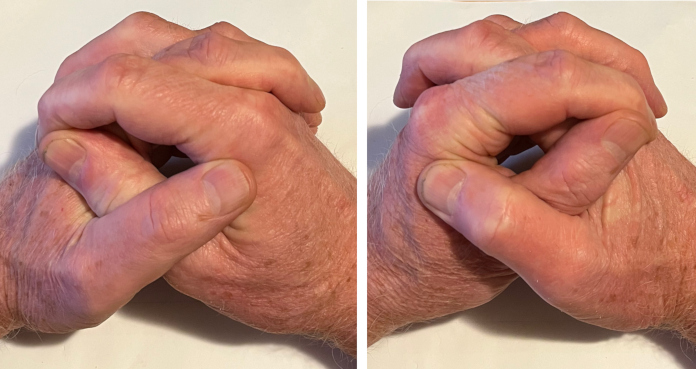
Ogah et al. (2012) found that there are actually four ways of clasping the hands. There were 92% of people who clasped their hands as shown above, alternating the fingers from the two hands (the R and L positions). But 8% of people had the thumb and forefinger of one hand touching; Ogah et al. (2012) called these positions R1 and L1. This means that an R1 individual has their right thumb on top of their left thumb, but for their other four fingers, the left is on top of the right. There have been a lot of studies of hand clasping, and I'm surprised that no one mentioned this before.
Hand clasping and handedness
You're probably wondering, is the way you clasp your hands related to whether you're right- or left-handed? Reiss (1999) reviewed the literature and counted 13 out of 21 studies that found a significant relationship between hand clasping and handedness. Tran et al. (2014) collected a large sample size (over 12,000 people) and found that 52% of righthanded people and 41% of lefthanded people were R claspers. It does seem like R handclasping is a little more common in right-handed people, but the difference is small enough that only very large studies find enough left-handed people to see the difference.
Many of the studies of hand clasping have looked for differences in hand-clasping preference between sexes, and associations of handclasping and arm folding, and they've found that any relationships are weak and inconsistent (Reiss 1999).
Family studies
Lutz (1908) was the first to look at hand clasping in parents and offspring. L×L matings produced a higher proportion of L offspring than did R×R matings, which suggests there is some genetic influence on the trait. However, the large number of R offspring of two L parents and L offspring of two R parents means that hand clasping preference is not determined by a single gene with two alleles.
| Parents | L offspring | R offspring | percent L |
|---|---|---|---|
| L×L | 63 | 46 | 58% |
| L×R | 113 | 147 | 56% |
| R×R | 63 | 166 | 27% |
Despite the clear results from Lutz's (1908) data set, people continued to look at hand clasping in parents and offspring. Reiss (1999) summarized data from 18 publications, with the following totals across all studies:
| Parents | L offspring | R offspring | percent L |
|---|---|---|---|
| L×L | 1252 | 880 | 59% |
| L×R | 2309 | 2573 | 47% |
| R×R | 1298 | 2815 | 32% |
Reiss (1999) concluded that there may be some genetic basis for this character, but it's not a simple one-gene trait. Lutz (1908) reached the same conclusion based on the same kind of data, and while replication is important in science, it seems kind of silly that people did 17 more family studies in the next 90 years.
McManus and Mascie-Taylor (1979) fitted a three-allele model to family and population data, in which one allele caused R hand clasping, one caused L, and one allele caused a 50:50 mix of R and L. As McManus and Mascie-Taylor (1979) say, "It is thus probable that this model will be able to fit almost any data in view of the large number of free variables," and sure enough, they find combinations of allele frequencies and dominance relationships that fit their data.
Twin studies
Reiss (1999) summarized data from four twin studies. In all of the studies, there are many pairs of identical twins where one is L and the other is R, indicating that there is little genetic influence on this character:
| Monozygotic | Dizygotic | |
|---|---|---|
| Both L | 106 | 101 |
| Both R | 103 | 67 |
| L + R | 157 | 131 |
Genome studies
Erikkson et al. (2010) looked at about 535,000 single-nucleotide polymorphisms (SNPs) in about 10,000 customers of 23andMe, and they did not find a significant association of any SNP with hand-clasping preference. This is a lot of SNPs and a pretty large number of people, so if there are any genes that affect hand-clasping, their effects are pretty weak.
Further research
No more research is needed on the genetics of hand clasping, but there are some interesting questions that could be answered with fairly easy research. There are still people publishing papers that use hand clasping as an example of "laterality" (difference between right and left), so it might be worthwhile for someone to do another study like Sharma and Nath (1971) to see how consistent people's hand clasping is; it would be a fun and easy classrooom project. It would also be worthwhile to get another estimate of how many people clasp their hands with thumb and forefinger of the same hand together (the R1 and L1 types of Ogah et al. [2012]).
Off the top of my head, here are some other questions about hand clasping. For people who have a strong preference, is there an anatomical difference between their hands that makes one method of clasping more comfortable? Do babies and toddlers have a preference, or does it develop later in life? If people with a strong preference force themselves to clasp their hands the wrong way, does it eventually get equally comfortable?
Mohr et al. (2003) found that L hand claspers who fold their arms with right arm on top have significantly more "magical ideation" than the other three arm folding/hand clasping combinations. Any relation between hand clasping and brain function seems pretty unlikely to me, but I suppose someone should follow up on this.
References
Eriksson, N,, J.M. Macpherson, J.Y. Tung, L.S. Hon, B. Naughton, S. Saxonov, L. Avey, A. Wojcicki, I. Pe'er, and J. Mountain. 2010. Web-based, participant-driven studies yield novel genetic associations for common traits. PLoS Genetics 2010. 6:e1000993.
Lutz, F.E. 1908. The inheritance of the manner of clasping the hands. American Naturalist 42.495: 195-196.
Mohr, C., G. Thut, T. Landis, and P. Brugger, 2003. Hand, arms, and minds: Interaction between posture and thought. Journal of Experimental and Clinical Neuropsychology 25: 1000-1010.
Ogah, I., E. Stewart, M. Treleaven and R.J. Wassersug. 2012. Hand clasping, arm folding, and handedness: Relationships and strengths of preference. Laterality 17: 169-179.
Reiss, M. 1999. The genetics of hand-clasping: A review and a familial study. Annals of Human Biology 26: 39-48.
Sharma, A., and S. Nath, S. 1971. A methodological assessment of handedness and hand-clasping. Anthropologist 28: 57-66.
Wiener, A.S. 1932. Observations on the manner of clasping the hands and folding the arms. American Naturalist 66: 365-370.
Go to John McDonald's home page
This page was last revised October 26, 2026. ©2026 by John H. McDonald. Content is available under the Creative Commons Attribution-Noncommercial license.